Security · post-quantum, cryptography, migration, standards
The post-quantum gap is signatures, and the 2030 deadline belongs to your inventory
MITRE rated eight enterprise technologies: key establishment ships in five, signatures in two, and none reaches FIPS 140-3 validation. US federal deadlines now sit in 2030 and 2031.
 Security
Key points
- MITRE's September 2026 report found post-quantum key establishment in general release in five of the six categories where it applies, but post-quantum signatures in only two of eight.
- Executive Order 14412 gives US federal agencies until 31 December 2030 to move high-value systems to post-quantum key establishment and until 31 December 2031 for signatures.
- NIST removes quantum-vulnerable algorithms from its standards by 2035, so the first deliverable is a cryptographic inventory and a procurement clause, not an algorithm decision.
What MITRE actually measured
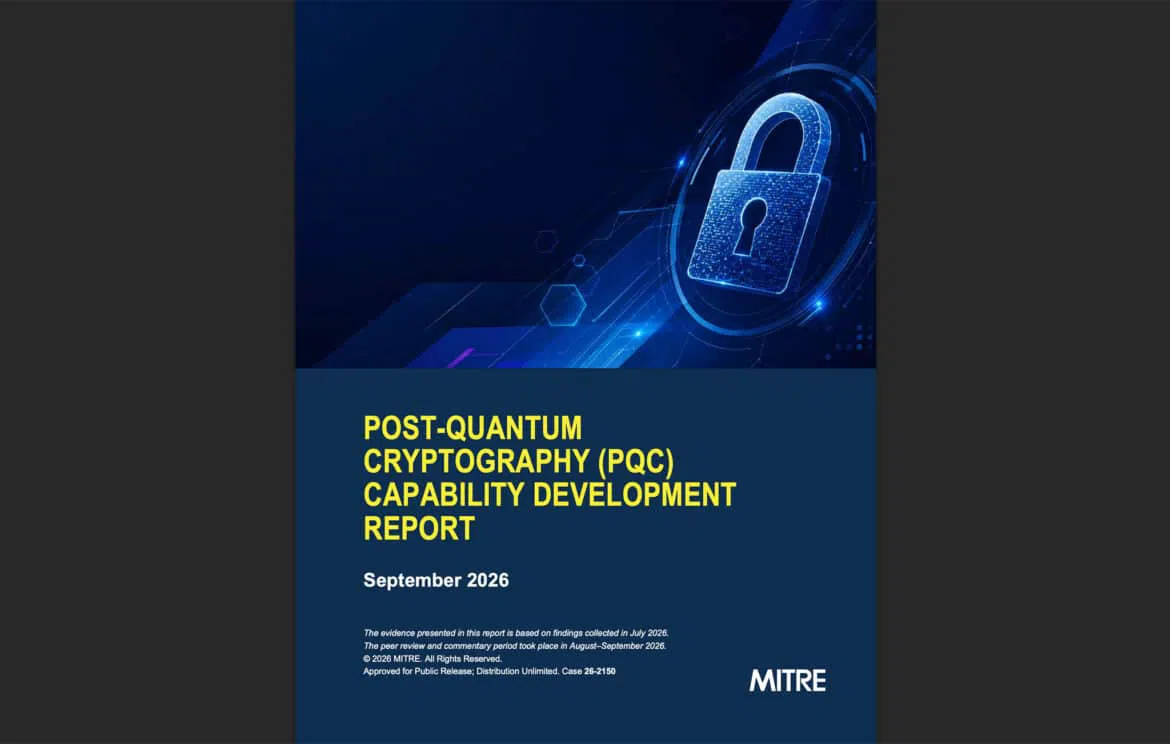
The Post-Quantum Cryptography Coalition published MITRE's PQC Capability Development Report on 15 October 2026. The report is dated September 2026 and every rating was built from public evidence collected in July 2026, which makes it a snapshot of shipping product rather than of vendor roadmaps. MITRE scored eight categories of enterprise technology on two separate tracks, one for key establishment and one for digital signatures, and marked a track not applicable where a technology does not rely on that guarantee.
The scale has six levels, from blocked through enabled, components available, preliminary integration and integration, up to validated integration. The top rung requires a general release that supports post-quantum functions through a FIPS 140-3 validated module certified for them. No category reached it.
Key exchange shipped first, and signatures did not
MITRE found post-quantum key establishment in general release in five of the six categories where it applies: web browsers, web servers, VPN and network encryption, PKI and certificate authority management, and cloud service connectivity. The reason is mechanical. Key establishment is negotiated inside a protocol the vendor already controls, so a library upgrade changes the behaviour of a connection without changing what the enterprise has to buy.
Signatures are a different problem, because a signature outlives the session that produced it. MITRE found post-quantum signatures in general release in two of its eight categories, code signing and PKI and certificate authority management, and validated in none. It also found no evidence of a commercially available post-quantum hardware TPM, which is the part that decides how long an estate carries a quantum-vulnerable root of trust through a hardware refresh cycle.
The asymmetry has a cost consequence that is easy to miss. Key establishment is a library upgrade the platform team can schedule in a maintenance window. Signatures sit in firmware, in code-signing pipelines and in certificate hierarchies that were designed to change slowly, and the private keys behind them may live in hardware that has no post-quantum replacement to buy yet.
Advertisement
Three workstreams, three different deadlines
The practical consequence is that a migration plan with one date in it will be wrong. The three workstreams move at different speeds, are governed by different standards and are blocked by different suppliers, so they need to be tracked separately in the estate plan.
| Key establishment | Code and document signatures | Hardware roots of trust | |
|---|---|---|---|
| MITRE's finding | General release in 5 of 6 categories | General release in 2 of 8 categories | No commercial post-quantum TPM found |
| NIST standard | FIPS 203, ML-KEM | FIPS 204 and FIPS 205 | FIPS 140-3 validated module |
| US federal deadline | 31 December 2030 | 31 December 2031 | Follows the hardware refresh |
| Buyer question | Where does TLS terminate today | Which artefacts are signed and by whom | Replace the fleet or wait for a module |
Why the dates land in 2030 rather than 2035
Executive Order 14412 sets the near dates. US federal agencies have until 31 December 2030 to move high-value assets and high-impact systems outside national security systems to post-quantum key establishment, and until 31 December 2031 to move them to post-quantum signatures. Those are federal deadlines, and a commercial enterprise is not bound by them, but they set the date at which the products an enterprise buys are being engineered to a schedule.
NIST's own transition timeline is longer and it is the one that governs the standards. Under NIST IR 8547, quantum-vulnerable algorithms will be deprecated and ultimately removed from NIST's standards by 2035, with high-risk systems transitioning much earlier. The G7 cybersecurity working group, whose statement is jointly published by the cyber agencies of Canada, Germany, Italy, France, the US, the UK and Japan with the European Commission, says private-sector migration is expected to be completed during the 2030s. Read together, 2030 is when the components must exist, 2031 is when the federal estate must use them and 2035 is when the old algorithms leave the standards.
Advertisement
The 2030 deliverable is an inventory
The G7 guidance is unusually specific about the first artefact, and it is not a cryptographic suite. The fundamental step to becoming cryptographically agile is the ability to detect weaknesses in deployed systems and to know where changes will need to be made, which requires a complete cryptographic inventory that is continuously maintained. The recommended machine-readable form is a cryptographic bill of materials, an extension of an SBOM that describes the algorithms in use and the dependencies between them.
Prioritisation follows from the inventory rather than from the calendar. The published factors are the potential damage if the data were obtained, the lifespan of the data, where the data is exposed and how long the system takes to migrate. The last one carries the surprise: a certificate authority or a PKI takes years to move, so a system with a low data classification but a long migration path can outrank a more sensitive one with a short path. The G7 suggests a three-level qualitative rating, low, medium and high, which is enough to order the work.
What to do before the first vendor call
Two stated facts should shape the buying conversation. Post-quantum cryptography will only be available in TLS 1.3 and later, so a web service still negotiating TLS 1.2 may need a software upgrade, an operating system upgrade, replacement infrastructure or all three. And a product can be tested by its vendor and still fail interoperability against another vendor's implementation, because implementations make different assumptions, which is why the G7 recommends adding post-quantum tests to the existing test plan rather than trusting a conformance statement.
The decision rule is therefore about evidence. A supplier that can produce a cryptographic inventory for its own product, name the FIPS standard it implements for key establishment and for signatures separately, and state whether its module is FIPS 140-3 validated is answering the 2030 question. One that answers with a roadmap date is answering a different question. Put the requirement in the tender: the published guidance says PQC requirements will need to be included in tenders to ensure the security of products in the coming years, and that a procurement contract is the right place to require a cloud provider to support PQC.
Advertisement
Sources 3
- 1PostQuantum — MITRE Rated Eight Enterprise Technologies on Post-Quantum Readiness. Key Exchange Is in General Release in Five, Signatures in Two.
- 2NIST CSRC — Post-Quantum Cryptography
- 3Canadian Centre for Cyber Security — G7 Cybersecurity Working Group Statement on preparing for a post-quantum cryptography migration